Older Australians
Living alone or with a partner, wanting to stay put rather than move into care.

Independent living
For older Australians and people with disability — and for the family and carers who worry from another suburb.
Most people do not want a nurse call button. They want to stay where they are, without their children lying awake.
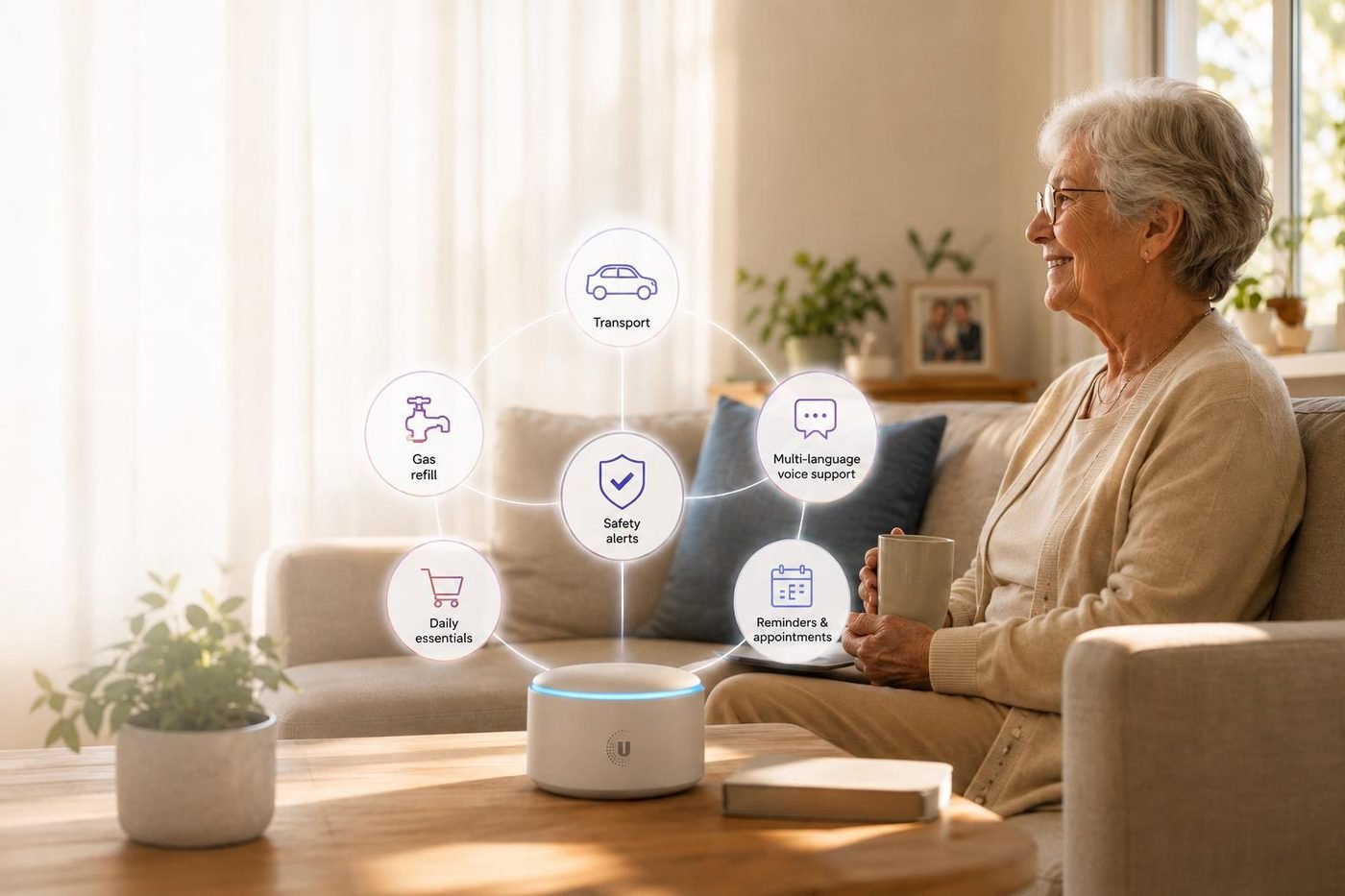
Sensors around the home notice movement and daily rhythm — the kettle, the bathroom, the front door — and build a picture of an ordinary day. When something falls outside that routine, the system can alert the people who have been given access. No camera in the bedroom, no live video feed of anyone’s life.
Radar-style sensing works through steam and in the dark, and it does not need to be worn, charged or remembered. It reads the shape of a room, not a face. A fall in the bathroom at 2am should not depend on someone remembering to wear a pendant.
Then she does not have to. Speaking normally, in the room she is standing in, is the whole interface. No phone to unlock, no menu to learn, no password. The app is there for family and carers when they need it; she does not need one to use the home.
Family and carers can be given their own view — and she decides who gets it, and what they can see. Oversight is granted, not assumed, and it can be taken back at any time.
Living alone or with a partner, wanting to stay put rather than move into care.
Voice control of doors, lights, blinds and appliances for people for whom a switch on the wall is not a given.
A quiet daily reassurance instead of a phone call that has to be answered.
Being designed to support people across a portfolio of homes, with a written record of what the system did and when.
Dignity by design
A system that helps a vulnerable person has to be built to a higher standard than one that turns on a light. These are constraints we are building into the system, not promises added later in a brochure.
Bedrooms and bathrooms are sensed by radar, which reads a shape and a fall, never a picture.
Every carer or family view is granted by the resident and can be withdrawn by the resident.
Anything with a cost or a consequence stays within permissions and limits set by the resident.
A timestamped record of what the system did and why, designed to support review by a family or an auditor.
The system is being designed to treat health and care information as sensitive information under Australian privacy requirements.
We would rather be straight with you than sell you a rendering. Here is what exists today.
Speaking to the house and being understood, entirely on site. Control of real devices across brands. A working phone app. Household data kept inside the home by default, with access controlled by the household.
The self-setup wizard, installer tooling, and the carer and provider dashboard.
Real-home pilot deployment, service integrations and the tools needed to support rollout.